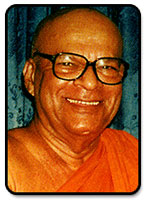
至诚祝愿:
愿三宝加持予...我们尊重敬爱的:达摩难陀长老
达摩难陀长老

-
爱心博士
- Posts: 153
- Joined: 14-06-06 Wed 5:52 pm
- Location: 钻石湾
Dear Bros and sis,
fyi
这是今天收到法友转发来的信件,但愿这是个好的状况.........
祝愿长老 : 身心离苦,康宁...........
Dear Yin Onn,
latest update on Chief. Seems like he is making progress. We did an offering
for him this morning at Meru.. Bro Lim and Susan And quite a few of us. We
hope he will improve further.
with metta,
kok wai.
fyi
这是今天收到法友转发来的信件,但愿这是个好的状况.........
祝愿长老 : 身心离苦,康宁...........
Dear Yin Onn,
latest update on Chief. Seems like he is making progress. We did an offering
for him this morning at Meru.. Bro Lim and Susan And quite a few of us. We
hope he will improve further.
with metta,
kok wai.
爱心启航,白袍扬帆,博极医源,精勤不倦。
-
91/93MPTAA
- Posts: 396
- Joined: 28-06-06 Wed 7:13 pm
- Location: 南马
愿达摩难陀长老远离生理和心理的痛苦!
Sadhu~Sadhu~Sadhu~
Sadhu~Sadhu~Sadhu~
愿正法久住于世间!
-
91/93MPTAA
- Posts: 396
- Joined: 28-06-06 Wed 7:13 pm
- Location: 南马
达摩难陀长老离开我们了~
刚刚接到佛友从Subang Jaya Medical Centre的来电,长老在31-8-2006 12:40pm离开我们了。
谨此通告所有佛友~

长老一生的照片


刚刚接到佛友从Subang Jaya Medical Centre的来电,长老在31-8-2006 12:40pm离开我们了。
谨此通告所有佛友~
长老一生的照片
Last edited by 91/93MPTAA on 31-08-06 Thu 2:12 pm, edited 1 time in total.
愿正法久住于世间!
-
老黄

- Site Admin
- Posts: 29109
- Joined: 29-07-05 Fri 12:07 am
- Location: 太平 --〉关丹
- Contact:
是的,刚刚也收到了消息。
我刚想发帖回应楼上几位的帖子,却收到了这个消息。
还是要说一说。
楼上的怎么祝愿起长老脱离痛苦?长老痛苦了么?
如果是,长老就不是大修行人了。
一个多月前,我到过十五碑佛寺,见到长老。
长老虽然瘦了很多,但是精神却很好。
我向寺里的负责人要求去顶礼老法师,老法师笑笑,还对我说很久没有到关丹了。
长老罹病多年,长期服药打针,最近更听说长老得了癌症。
如果您之前看过长老吃药打针,是那么的洒脱!如果您问他病情,他会笑言许多有趣的事,完全不把病放在眼里。
印顺法师以一身病体活了100岁,是个异数。
从他的传记中得知,有好几次他都从死亡边缘中走回来。
患重病时,他往往都是选择放弃治疗,希望任运自然。的确,修行人还那么在乎生死,又哪里还算修行?但是,最终导师还是在弟子们的劝告下,接受了治疗。用普贤行愿品的说法,这叫“请佛住世”。
长老病中也是如此。
VIHARA发出的消息说,医生希望他的弟子们可以劝告长老,希望他有强韧的求生意志,因为这是治疗的一个动力。显然,长老并不如此。
因此,我相信,长老在病中,无论是身心,都不会痛苦。
我们要祈愿的是长老得以住世。
说实在的,长老的佛教大师地位,在短期内是无法有人可以代替的。
过去,官方或佛教界有什么问题,最终都选择咨询长老。长老的话就是大家所听从的。
教内教外办研讨会探讨社会课题,若要寻求佛教界的代言人,也必然想到长老。他的话有分量,他的观点既尖锐又准确。
长老走了,这个空缺难于填补。
只希望大家在告别长老之后,多学习长老的精神以及智慧,为自己、为佛教、为众生谋求更大的进步。

我刚想发帖回应楼上几位的帖子,却收到了这个消息。
还是要说一说。
楼上的怎么祝愿起长老脱离痛苦?长老痛苦了么?
如果是,长老就不是大修行人了。
一个多月前,我到过十五碑佛寺,见到长老。
长老虽然瘦了很多,但是精神却很好。
我向寺里的负责人要求去顶礼老法师,老法师笑笑,还对我说很久没有到关丹了。
长老罹病多年,长期服药打针,最近更听说长老得了癌症。
如果您之前看过长老吃药打针,是那么的洒脱!如果您问他病情,他会笑言许多有趣的事,完全不把病放在眼里。
印顺法师以一身病体活了100岁,是个异数。
从他的传记中得知,有好几次他都从死亡边缘中走回来。
患重病时,他往往都是选择放弃治疗,希望任运自然。的确,修行人还那么在乎生死,又哪里还算修行?但是,最终导师还是在弟子们的劝告下,接受了治疗。用普贤行愿品的说法,这叫“请佛住世”。
长老病中也是如此。
VIHARA发出的消息说,医生希望他的弟子们可以劝告长老,希望他有强韧的求生意志,因为这是治疗的一个动力。显然,长老并不如此。
因此,我相信,长老在病中,无论是身心,都不会痛苦。
我们要祈愿的是长老得以住世。
说实在的,长老的佛教大师地位,在短期内是无法有人可以代替的。
过去,官方或佛教界有什么问题,最终都选择咨询长老。长老的话就是大家所听从的。
教内教外办研讨会探讨社会课题,若要寻求佛教界的代言人,也必然想到长老。他的话有分量,他的观点既尖锐又准确。
长老走了,这个空缺难于填补。
只希望大家在告别长老之后,多学习长老的精神以及智慧,为自己、为佛教、为众生谋求更大的进步。
-
老黄
- Site Admin
- Posts: 29109
- Joined: 29-07-05 Fri 12:07 am
- Location: 太平 --〉关丹
- Contact:
长老生平
[转贴] 达摩难陀长老网站
http://www.ksridhammananda.com/life_1.htm
Early Life
Venerable Dhammananda was born on March 18, 1919 to the family of Mr. K.A. Garmage in the village of Kirinde, Matara in southern Ceylon. Like most children born during the British colonial period, he was given the English name of Martin. He was the eldest in a family of three brothers and three sisters.
He began his formal secular education in a government school in the village of Kirinde at the age of seven. Even as a young child he had a keen interest in the Buddha's teachings. Buddhism was close to the hearts of the villagers because of the strong presence of the sangha which successfully used the local vihara as the vortex of most religious activities and functions.
The young Martin participated in many of these religious programmes which were based on Buddhist principles and morals. He also had an uncle who was the chief monk of the local temple. Together with his devout mother, his uncle provided much spiritual guidance in his childhood days. Thus, the idea of monkhood slowly seeped into his mind.
When he was 12 years old, he was ordained as a novice monk (samanera) by Venerable K. Dhammaratana Maha Thera of Kirinde Vihara. He was given the name "Dhammananda" meaning "one who experiences happiness through the Dharma." He then underwent ecclesiastical education for the next 10 years before he was fully ordained as a full-fledged monk bhikkhu) in 1940. His Preceptor was Venerable K. Ratanapala Maha Thera of Kotawila Vihara. Thus, at the age of 22, samanera Dhammananda became bhikkhu Dhammananda upon receiving the higher ordination (upasampada).
HIGHER EDUCATION AND TRAINING
Venerable Dhammananda enrolled at the Sri Dhammarama Pirivena, Ratmalana in 1935, and then at the Vidyawardhana Buddhist Institute, Colombo, 1937 for a more detailed study of the Buddha's teaching. His mentor was Venerable Kotawila Deepananda Nayaka Thera. Upon completion of his studies in 1938, he entered Vidyalankara Pirivena, in Peliyadoga, Kelaniya, a prestigious Buddhist college that has since been upgraded into a university
For the next seven years, Venerable Dhammananda attended a diploma programme at the Vidyalanka Pirivena where he studied Sanskrit, the Pali Tipitaka and Buddhist Philosophy, besides other secular subjects. His principal tutor at the Institute was Venerable Lunupokune Sri Dhammananda, an eminent scholar monk. At age 26 he successfully graduated with a diploma in Linguistics and Pali Tipitaka.
His seven years of intensive learning and training in monastic discipline from 1939-1945 at the Vidyalanka Pirivena provided him the relevant knowledge and skills in missionary techniques. He was able to use his training to assist the Buddhists in Ceylon, especially those who were English educated and had been prime targets of Christian proselytization, in understanding the more intellectual aspects of the Buddha's teachings.
In 1945 Venerable Dhammananda furthered his tertiary education at the Benares Hindu University in India where he was awarded a scholarship. At the university, he read Sanskrit, Hindi and Indian Philosophy. His contemporaries at the University included Venerable P. Panananda Nayaka Thera of Colombo, Venerable Dr. H. Saddhatissa Maha Thera (who later became head of the London Buddhist Vihara), Venerable Dr. U. Dhammaratana and the late Venerable Dr. Amritananda Thera, former head of the Sangha of Nepal. Venerable Dhammananda studied four years at the university graduating with a Master of Arts degree in Indian Philosophy in 1949. Among the many well-known professors who taught him was the late Dr. S. Radhakrishnan, who later became President of the Republic of India.
Having completed his studies, Venerable Dhammananda returned to Ceylon. In Kotawilla he established the Sudharma Buddhist Institute and tended to the educational, welfare and religious needs of the villagers. He also published a quarterly Buddhist journal "Sudharma" in Sinhalese. He gave regular teachings to the devotees to improve their knowledge and practice of Buddhism.
THE MISSION TO MALAYA
In 1952, Venerable K. Sri Pannasara Nayaka Thera, head of the Vidyalanakara Pirivena, received an invitation from the Sasana Abhiwurdhi Wardhana Society of Malaya requesting for a resident monk to administer to the religious needs of the Sinhalese Buddhist community in the country
From among 400 monks at the Vidyalankara Pirivena, Venerable Dhammananda was selected for the mission to Malaya. He readily accepted the invitation even though he had wanted to serve the Buddhist in his native land. He was fully aware that while Ceylon had many learned and dedicated monks, Malaya did not have enough qualified monks to conduct even a simple religious ceremony.
Malaya, during the 1950s, had very few Theravada Buddhist temples where devotees could learn the teachings. However, it was not short of temples as there were hundreds of Chinese and Thai Buddhist temples in the country. Devotees visited them mainly to request for blessings or to listen to their chanting. Such was the situation when Venerable Dhammananda set sail from Ceylon on January 2, 1952 for Malaya.
EARLY MISSIONARY ACTIVITIES
Venerable Dhammananda's journey to Malaya took three days. Upon his arrival in Penang on January 5, 1952, Venerable Dhammananda stayed at the Mahindarama Buddhist Temple.
The abbot then was Venerable K. Gunaratana Maha Nayaka Thera (1891-1964), a Sinhalese monk well known for his lucid and simple explanations of the Buddha's teachings. He took the opportunity to discuss with Venerable Gunaratana some of the problems and issues involved in propagation work in Malaya. It was a practical arrangement, with Venerable Gunaratana concentrating his missionary efforts in Penang while Venerable Dhammananda focussed on the Kuala Lumpur area. Venerable Gunaratana had been in Malaya since 1926 and was quite familiar with the situation of Buddhism in the country.
Malaya during the 1950s was in the midst of the Emergency, declared by the British Military Administration, due to the Communist insurgency. As a result he had to take a flight to Kuala Lumpur as the train services in the country were disrupted by Communist attacks. He arrived at the Brickfields Temple, and was warmly welcomed by Venerable M. Pannasiri Maha Thera, a former colleague from the Vidyalankara Pirivena. Having come to serve the Buddhist community in Malaya, Venerable Dhammananda wasted no time in planning out the religious activities at the Temple
NATION BUILDING
In March 1952, Venerable Dhammananda received a letter from the secretary to Sir Gerald Templer, then British High Commissioner of Malaya, requesting for a meeting. Sir Gerald Templer wanted to know if Buddhist teachings were similar to Communism because many of the suspected Communist insurgents were Chinese who were also traditionally regarded as Buddhists. Sir Templer's misconception of Buddhism was corrected when Venerable Dhammananda convinced him that Buddhism is a non-violent and compassionate religion
Venerable Dhammananda further explained to Sir Gerald Templer that Buddhism teaches the spiritual and moral aspects of living whereas Communism is a political movement. Convinced that Venerable Dhammananda was not "fifth column" for the communists, Sir Templer instead invited him to aid the Government in its psychological war to win the "hearts and minds" of the people. The main target of the Government were the Chinese inhabitants at the New Villages.
With the assistance of Venerable Pannasiri, he started his missionary activities in the country. Both the Sasana Abhiwurdhi Wardhana Society and the Selangor Regional Centre of the World Fellowship of Buddhist gave support to his early missionary activities in the country. With a sincere mind and a tactful approach, Venerable Dhammananda's visits to the Chinese New Villages were welcomed without hostility or suspicion.
Venerable Dhammananda had only one motivation when he visited the New Villages - to impart the message of the Buddha to the villagers so that with a proper understanding of Buddhism they could lead a life of peace, happiness and goodwill. He believed that his prime duty as a Buddhist monk is to teach Buddhism to more people. As he was unable to communicate in Chinese when he visited the villagers in places like Ampang and Sungei Buloh, translators were used during his talks.
As a result of Venerable Dhammananda's missionary efforts, many Chinese in the country became aware of the real teachings of the Buddha. It was common for many Chinese in Malaysia to regard themselves as Buddhist because of past traditions. However, many of them did not understand the teachings of the Buddha. They mistook the customs and traditions that they grew up with, or those practised by their parents and grandparents as being part of Buddhism. Unfortunately, many of these customs and traditions were based on superstitious beliefs handed down from the past. This resulted in Buddhism receiving a very bad image and regarded as an out-dated and superstitious religion by the educated strata of society.
At the same time, Christian missionaries were actively converting the Chinese and Indians in the country to Christianity. As they were prohibited from preaching to the Malays because of the intervention of the Malay rulers, the non-Malays became prime target for Christian conversion. Venerable Dhammananda was almost alone in defending Buddhism against the onslaught of Christian missionaries during the 1950s, especially in the Kuala Lumpur region. He realized that the only way to prevent the young, educated Chinese from being converted was to ensure that they understood the proper teachings of the Buddha. In all his talks, he presented Buddhism in a rational and logical manner to prove that it is compatible with modern science
CELEBRATION OF WESAK - THEN AND NOW
Wesak Day - the holiest of all Buddhist holy days - marks the birth, enlightenment and final passing away of the Buddha. The Buddha was born as Prince Siddharta Gautama on a full moon day in the month of Wesak (month of May in present day calendar) in 623 BC. Siddharta began his search for enlightenment at age 29 and after six years realized the eternal truth, thus becoming the Buddha - which means the Awakened One. This auspicious event took place at dawn in the month of Wesak in 588 BC, which was also a full moon day. The Buddha taught the truth for 45 years until his final passing away into Nirvana on a full moon day in 543 BC. Thus, all the three major events in the Buddha's life happened on a full moon day in the month of Wesak. As such Buddhists of both the Theravada and Mahayana tradition throughout the world celebrate this thrice-blessed day.
Always a missionary at heart, Venerable Dhammananda regards the annual Wesak Day celebrations as a good time to explain the Buddha's teaching to hundreds of Chinese Buddhists who would otherwise not have visited the Brickfields Temple on other days. There are thousands of these so-called "Wesak Buddhists" who would only visit a Buddhist temple once a year during Wesak Day. Many of these "Wesak Buddhists" do not have a proper understanding of the Buddha's teachings. Hence, Venerable Dhammananda took the opportunity to organise exhibitions on Buddhism, give talks and distribute free booklets on Buddhism for the visitors during Wesak Day. In this way even though they visit the temple only once a year, their trip would have been meaningful because they would have learnt about the Dharma.
WORKING TOWARDS A MALAYSIAN SANGHA:
THE ANNUAL NOVITIATE PROGRAMME
Venerable Dhammananda knew from Buddhist history that the growth and spread of the religion had always been through the Sangha, especially a homegrown Sangha. Therefore, in December 1976 he initiated the first novitiate programme for English-educated Buddhist at the Brickfields Temple.
The objective of the novitiate programme is to provide the Malaysian Buddhists an opportunity to experience life as a monk. It has since become an annual affair where the Novitiate programme runs for about two weeks during the end-of-year school holidays.
Participants of the programme range from primary school children to retired professionals. Lady devotees are also encouraged to join in the annual programme by observing the 10 precepts of a lay disciple.
By establishing the Malaysian Novitiate Programme, Venerable Dhammananda has sown the seeds for a local Sangha. Since the first programme was launched, a few of the participants have now become full-time Sangha members. This augurs well for the Malaysian Buddhist community as it marks the beginning of an indigenous Sangha for the country. In 1980, a higher ordination ceremony of Venerable Sukita Dhamma (African American) was conducted at the Chapter House of the International Buddhist Pagoda at the temple by Venerable Dhammananda. Similar ordinations of other foreigners were also conducted from time to time.
THE ESTABLISHMENT OF THE BUDDHIST MISSIONARY SOCIETY
Venerable Dhammananda arrived in Malaya in 1952, first stopping in Penang before taking up residence at the Brickfields Temple, Kuala Lumpur. He came at the invitation of the Sasana Abhiwurdhi Wardhana Society (SAWS), which then catered mainly for the Sinhala Buddhist community. Working from this base, he energetically set about bringing Buddhism to Malaysians, mainly the English educated Chinese who began to visit the temple to hear him expound the Dharma. With his missionary zeal he realized that his ideals would be better achieved if he could set up a society to harness the energies of these newcomers to Buddhism.
Thus, in 1962 he established the Buddhist Missionary Society (BMS) at the Buddhist Temple. It is largely responsible for the propagation of Buddhism through publications and the sponsorship of Buddhist seminars, lectures and talks, as well as regular Dharma discussions, youth leadership training and welfare activities. Its role as a missionary society is clearly stated among its "aims and objects" as follows:
——To study and propagate Buddhism
——To encourage, foster and develop the qualities of truth, compassion and to practise the teachings of the Buddha
——To arrange religious lectures wherever possible
——To print Buddhist literature
——To assist in the opening of religious schools and to render assistance to Buddhist organizations where necessary
——To render spiritual assistance/advice to members or any Buddhist in case of sickness and/or death.
Even Venerable Dhammananda could not have envisaged the success of the BMS today. Using the Brickfields Temple (now known as the Buddhist Maha Vihara) as its base, working closely with SAWS, the BMS grew by leaps and bounds. It has been very effective in sponsoring the publication of numerous booklets and literature on Buddhism, many of them written by the Venerable himself. Popular titles by other well known writers were also reprinted. Many of these publications are for free distribution while others are for same at a very nominal price in order to ensure that more people have the opportunity to read the Dharma. Another successful project is the 12-lesson "Buddhism for You" Correspondence Course which was launched in 1979. Within a year more than 500 students had registered for the course.
The BMS, under the spiritual guidance of Veneral Dhammananda, has targeted at the younger generation in its many activities. Thus, a BMS Youth Section was established to organize activities for teenagers and those below 40 years, including the "Buddhism for Beginners" course for newcomers to the Dharma at the temple. A BMS ladies Section has also been established to provide religious and welfare activities. He was instrumental in founding the Society's magazine "The Voice of Buddhism" which today is in its 33rd year of publication. It is distributed free to members as well as readers all over the globe, carrying articles relevant to Buddhism as well as reporting the activities of the BMS and SAWS in the Buddhist Maha Vihara.
REACHING OUT TO THE MALAYSIAN BUDDHIST COMMUNITY
Venerable Dhammananda's outreach programme is not restricted to publications and talks within the confines of the Buddhist Maha Vihara. He travels extensively till today, despite his advanced age and occasional failing health to deliver talks on Buddhism throughout the country, including Sabah and Sarawak. In areas where the audience is predominately Chinese-speaking, the response is nevertheless still overwhelming though his talks are delivered through translations. He is also a regular speaker at public forums organized by Buddhist groups in Singapore. Like his talks in Malaysia, his public lectures on Buddhism in Singapore attracts hundreds of listeners.
He realizes that the future of Malaysian Buddhism depends on the young and the educated. Thus, he has always placed special emphasis on students, especially those in colleges and universities. Together with the late Venerable Sumangalo, an American Buddhist missionary monk, he was instrumental in encouraging Buddhist students at tertiary institutions to establish Buddhist societies in their campuses. Besides being a regular speaker at the various local colleges and universities, he has also organized special talks and discussions for campus students on Sunday mornings at the Buddhist Maha Vihara to broaden their knowledge and understanding of Buddhism.
It is not surprising therefore that he has been the main benefactor of the Buddhist Gem Fellowship (BGF), established in 1980 to act as an organization for Buddhist graduates to support the Buddhist student community in areas of training and religious education. The BGF has worked very closely with Venerable Dhammananda on missionary programmes for campus students and the Buddhist community at large. Thanks to his missionary work, many graduates of these tertiary institutions are now leaders of various Buddhist societies throughout the country.
With well over 300 Buddhist organizations throughout Malaysia representing the rich traditions of the Theravada, Mahayana and Vajrayana Buddhism, Venerable Dhammananda has always espoused a universal approach towards all these different groups. Many of the organizations follow the Chinese Mahayana tradition and are also affiliate members of the Young Buddhist Association of Malaysia (YBAM). Others belong to the various schools of Vajrayana Buddhism.
Venerable Dhammananda, however, has always encouraged open-mindedness among his devotees. He has invited H.H. Dalai Lama and many other well-known Tibetan Buddhist teachers to visit the Buddhist Maha Vihara and give talks. Similarly, the late Venerable Master Hsuan Hua has also delivered teachings at the Buddhist Maha Vihara. In Penang he was on the same stage with Venerable Hsin Yin of Taiwan to address a public forum on Buddhism titled "Two Masters, One Message". All these speak of his openness and spiritual maturity in understanding and catering to the religious needs of the Malaysian Buddhist community who follow different Buddhist traditions.
ON THE INTERNATIONAL FRONT
Venerable Dhammananda's reputation as a Buddhist missioner and scholar is well known both within Malaysia and overseas. In his younger days he used to travel overseas to give talks on Buddhism at major Buddhist conferences and meetings. While he occasionally attended as a participant representing Malaysia, he was usually invited as a conference speaker, especially at meetings organized by the World Fellowship of Buddhists, World Conference on Religion and Peace, World Sangha Council and the Asian Council on Religion and Peace. At the same time he has participated in numerous academic conferences on religion and philosophy as the spokesperson for Buddhism.
Many Buddhist groups in the West have invited Venerable Dhammananda to deliver Buddhist talks. In 1970 and 1975, he visited England and the United States at the invitation of Buddhist groups and academic societies in both countries. In Britain, he addressed students at Lancaster University, Hull University, Manchester University and Oxford University. In the United States he spoke to students at two Buddhist Universities, i.e. Dharma Realm Buddhist University in Talmage, California and University of Oriental Studies in Los Angeles. He also visited many other countries to give religious talks including Australia, New Zealand, Indonesia, Singapore and Sri Lanka.
As a result of his extensive travels and contacts, he has successfully established a wide and effective network with Buddhist groups in both traditional Buddhist countries such as Sri Lanka, Thailand, Myanmar, Taiwan and Japan and in non-Buddhist countries including Australia, Britain and the United States.
MALAYSIA & SINGAPORE SRI LANKA SANGHA COUNCIL
The contribution of Sri Lankan monks to the rebirth and development of Buddhism in South East Asia has been immense, especially in Malaysia, Singapore and Indonesia. The revival which began in the early 20th Century has been sparked mainly by the exodus of Sri Lankans to Malaya who brought with them able religious teachers from Sri Lanka to cater to the spiritual and cultural needs of the Sinhalese Buddhist fraternity.
Some of these monks however have gone beyond their primary duties of catering to the Sinhalese to serve the greater Buddhist population. Ven Dhammananda being the Chief Sanga Nayaka of Malaysia and Singapore was elected the President of this Council.
Venerable Dhammananda being fully aware that 'There is no success without a successor' mooted the idea of convening a Sri Lankan Sangha Conference to chart the future direction of Buddhist work in Malaysia and Singapore. The Sasana Abhiwurdhi Wardhana Society being the oldest Buddhist Society in Malaysia galvanised its resources to carry out the Venerable's suggestion. The Sangha Conference was held at the Buddhist Maha Vihara on 24th March 2001 which resulted in the formation of the Malaysia & Singapore Sri Lanka Sangha Council.
Ven Dhammananda has resolved to produce leaders who could produce other leaders. No longer was it enough to grow by adding leaders. Ven Dhammananda's focus is now upon multiplying those leaders. The Venerable strongly believes that when people work for a common cause, they no longer add to their growth potential. Their unity multiplies their strength.
PUBLICATIONS
One of Venerable Dhammananda's greatest contributions to the cause of Buddhism must surely be in the area of publications. Over the last four decades he has written profusely and his works have touched not only Buddhists, but also non-Buddhists both within Malaysia and in different parts of the world. Very early in his missionary career he has recognised the power and durability of the written word. Books could be stored, distributed and referred to all over again in a manner that can never be replaced by the spoken word.
His books are written in response to a very real and practical need. During his frequent Dhamma talks, devotees and interested listeners asked him numerous questions regarding the practice of Buddhism. After answering their questions he was inspired to commit them to writing, and this soon led to the revision and publication of new books.
Thirty to forty years ago there was a dire need for such books. Today he has to his credit no less than 60 important books ranging from simple pamphelts to full scale texts exceeding 700 pages. There is a sizeable number of English educated Buddhists in Malaysia who need to understand Buddhism in a rational and practical manner. Venerable Dhammananda responded to this need. There were more request and these books began to find their way to other English speaking communities across the globe - the U.S.A., Europe, parts of Africa, Australia, other Asian countries and some parts of the Middle East. Non English-speaking Buddhists have also benefited when these works were translated into various languages - Chinese, Sinhalese, Tamil, Vietnamese, Dutch, Spanish, Korean, Hindi, Bengali, Indonesian, Persian, Bahasa Malaysia, Burmese, Japanese, Nepalese and Portuguese.
[转贴] 达摩难陀长老网站
http://www.ksridhammananda.com/life_1.htm
Early Life
Venerable Dhammananda was born on March 18, 1919 to the family of Mr. K.A. Garmage in the village of Kirinde, Matara in southern Ceylon. Like most children born during the British colonial period, he was given the English name of Martin. He was the eldest in a family of three brothers and three sisters.
He began his formal secular education in a government school in the village of Kirinde at the age of seven. Even as a young child he had a keen interest in the Buddha's teachings. Buddhism was close to the hearts of the villagers because of the strong presence of the sangha which successfully used the local vihara as the vortex of most religious activities and functions.
The young Martin participated in many of these religious programmes which were based on Buddhist principles and morals. He also had an uncle who was the chief monk of the local temple. Together with his devout mother, his uncle provided much spiritual guidance in his childhood days. Thus, the idea of monkhood slowly seeped into his mind.
When he was 12 years old, he was ordained as a novice monk (samanera) by Venerable K. Dhammaratana Maha Thera of Kirinde Vihara. He was given the name "Dhammananda" meaning "one who experiences happiness through the Dharma." He then underwent ecclesiastical education for the next 10 years before he was fully ordained as a full-fledged monk bhikkhu) in 1940. His Preceptor was Venerable K. Ratanapala Maha Thera of Kotawila Vihara. Thus, at the age of 22, samanera Dhammananda became bhikkhu Dhammananda upon receiving the higher ordination (upasampada).
HIGHER EDUCATION AND TRAINING
Venerable Dhammananda enrolled at the Sri Dhammarama Pirivena, Ratmalana in 1935, and then at the Vidyawardhana Buddhist Institute, Colombo, 1937 for a more detailed study of the Buddha's teaching. His mentor was Venerable Kotawila Deepananda Nayaka Thera. Upon completion of his studies in 1938, he entered Vidyalankara Pirivena, in Peliyadoga, Kelaniya, a prestigious Buddhist college that has since been upgraded into a university
For the next seven years, Venerable Dhammananda attended a diploma programme at the Vidyalanka Pirivena where he studied Sanskrit, the Pali Tipitaka and Buddhist Philosophy, besides other secular subjects. His principal tutor at the Institute was Venerable Lunupokune Sri Dhammananda, an eminent scholar monk. At age 26 he successfully graduated with a diploma in Linguistics and Pali Tipitaka.
His seven years of intensive learning and training in monastic discipline from 1939-1945 at the Vidyalanka Pirivena provided him the relevant knowledge and skills in missionary techniques. He was able to use his training to assist the Buddhists in Ceylon, especially those who were English educated and had been prime targets of Christian proselytization, in understanding the more intellectual aspects of the Buddha's teachings.
In 1945 Venerable Dhammananda furthered his tertiary education at the Benares Hindu University in India where he was awarded a scholarship. At the university, he read Sanskrit, Hindi and Indian Philosophy. His contemporaries at the University included Venerable P. Panananda Nayaka Thera of Colombo, Venerable Dr. H. Saddhatissa Maha Thera (who later became head of the London Buddhist Vihara), Venerable Dr. U. Dhammaratana and the late Venerable Dr. Amritananda Thera, former head of the Sangha of Nepal. Venerable Dhammananda studied four years at the university graduating with a Master of Arts degree in Indian Philosophy in 1949. Among the many well-known professors who taught him was the late Dr. S. Radhakrishnan, who later became President of the Republic of India.
Having completed his studies, Venerable Dhammananda returned to Ceylon. In Kotawilla he established the Sudharma Buddhist Institute and tended to the educational, welfare and religious needs of the villagers. He also published a quarterly Buddhist journal "Sudharma" in Sinhalese. He gave regular teachings to the devotees to improve their knowledge and practice of Buddhism.
THE MISSION TO MALAYA
In 1952, Venerable K. Sri Pannasara Nayaka Thera, head of the Vidyalanakara Pirivena, received an invitation from the Sasana Abhiwurdhi Wardhana Society of Malaya requesting for a resident monk to administer to the religious needs of the Sinhalese Buddhist community in the country
From among 400 monks at the Vidyalankara Pirivena, Venerable Dhammananda was selected for the mission to Malaya. He readily accepted the invitation even though he had wanted to serve the Buddhist in his native land. He was fully aware that while Ceylon had many learned and dedicated monks, Malaya did not have enough qualified monks to conduct even a simple religious ceremony.
Malaya, during the 1950s, had very few Theravada Buddhist temples where devotees could learn the teachings. However, it was not short of temples as there were hundreds of Chinese and Thai Buddhist temples in the country. Devotees visited them mainly to request for blessings or to listen to their chanting. Such was the situation when Venerable Dhammananda set sail from Ceylon on January 2, 1952 for Malaya.
EARLY MISSIONARY ACTIVITIES
Venerable Dhammananda's journey to Malaya took three days. Upon his arrival in Penang on January 5, 1952, Venerable Dhammananda stayed at the Mahindarama Buddhist Temple.
The abbot then was Venerable K. Gunaratana Maha Nayaka Thera (1891-1964), a Sinhalese monk well known for his lucid and simple explanations of the Buddha's teachings. He took the opportunity to discuss with Venerable Gunaratana some of the problems and issues involved in propagation work in Malaya. It was a practical arrangement, with Venerable Gunaratana concentrating his missionary efforts in Penang while Venerable Dhammananda focussed on the Kuala Lumpur area. Venerable Gunaratana had been in Malaya since 1926 and was quite familiar with the situation of Buddhism in the country.
Malaya during the 1950s was in the midst of the Emergency, declared by the British Military Administration, due to the Communist insurgency. As a result he had to take a flight to Kuala Lumpur as the train services in the country were disrupted by Communist attacks. He arrived at the Brickfields Temple, and was warmly welcomed by Venerable M. Pannasiri Maha Thera, a former colleague from the Vidyalankara Pirivena. Having come to serve the Buddhist community in Malaya, Venerable Dhammananda wasted no time in planning out the religious activities at the Temple
NATION BUILDING
In March 1952, Venerable Dhammananda received a letter from the secretary to Sir Gerald Templer, then British High Commissioner of Malaya, requesting for a meeting. Sir Gerald Templer wanted to know if Buddhist teachings were similar to Communism because many of the suspected Communist insurgents were Chinese who were also traditionally regarded as Buddhists. Sir Templer's misconception of Buddhism was corrected when Venerable Dhammananda convinced him that Buddhism is a non-violent and compassionate religion
Venerable Dhammananda further explained to Sir Gerald Templer that Buddhism teaches the spiritual and moral aspects of living whereas Communism is a political movement. Convinced that Venerable Dhammananda was not "fifth column" for the communists, Sir Templer instead invited him to aid the Government in its psychological war to win the "hearts and minds" of the people. The main target of the Government were the Chinese inhabitants at the New Villages.
With the assistance of Venerable Pannasiri, he started his missionary activities in the country. Both the Sasana Abhiwurdhi Wardhana Society and the Selangor Regional Centre of the World Fellowship of Buddhist gave support to his early missionary activities in the country. With a sincere mind and a tactful approach, Venerable Dhammananda's visits to the Chinese New Villages were welcomed without hostility or suspicion.
Venerable Dhammananda had only one motivation when he visited the New Villages - to impart the message of the Buddha to the villagers so that with a proper understanding of Buddhism they could lead a life of peace, happiness and goodwill. He believed that his prime duty as a Buddhist monk is to teach Buddhism to more people. As he was unable to communicate in Chinese when he visited the villagers in places like Ampang and Sungei Buloh, translators were used during his talks.
As a result of Venerable Dhammananda's missionary efforts, many Chinese in the country became aware of the real teachings of the Buddha. It was common for many Chinese in Malaysia to regard themselves as Buddhist because of past traditions. However, many of them did not understand the teachings of the Buddha. They mistook the customs and traditions that they grew up with, or those practised by their parents and grandparents as being part of Buddhism. Unfortunately, many of these customs and traditions were based on superstitious beliefs handed down from the past. This resulted in Buddhism receiving a very bad image and regarded as an out-dated and superstitious religion by the educated strata of society.
At the same time, Christian missionaries were actively converting the Chinese and Indians in the country to Christianity. As they were prohibited from preaching to the Malays because of the intervention of the Malay rulers, the non-Malays became prime target for Christian conversion. Venerable Dhammananda was almost alone in defending Buddhism against the onslaught of Christian missionaries during the 1950s, especially in the Kuala Lumpur region. He realized that the only way to prevent the young, educated Chinese from being converted was to ensure that they understood the proper teachings of the Buddha. In all his talks, he presented Buddhism in a rational and logical manner to prove that it is compatible with modern science
CELEBRATION OF WESAK - THEN AND NOW
Wesak Day - the holiest of all Buddhist holy days - marks the birth, enlightenment and final passing away of the Buddha. The Buddha was born as Prince Siddharta Gautama on a full moon day in the month of Wesak (month of May in present day calendar) in 623 BC. Siddharta began his search for enlightenment at age 29 and after six years realized the eternal truth, thus becoming the Buddha - which means the Awakened One. This auspicious event took place at dawn in the month of Wesak in 588 BC, which was also a full moon day. The Buddha taught the truth for 45 years until his final passing away into Nirvana on a full moon day in 543 BC. Thus, all the three major events in the Buddha's life happened on a full moon day in the month of Wesak. As such Buddhists of both the Theravada and Mahayana tradition throughout the world celebrate this thrice-blessed day.
Always a missionary at heart, Venerable Dhammananda regards the annual Wesak Day celebrations as a good time to explain the Buddha's teaching to hundreds of Chinese Buddhists who would otherwise not have visited the Brickfields Temple on other days. There are thousands of these so-called "Wesak Buddhists" who would only visit a Buddhist temple once a year during Wesak Day. Many of these "Wesak Buddhists" do not have a proper understanding of the Buddha's teachings. Hence, Venerable Dhammananda took the opportunity to organise exhibitions on Buddhism, give talks and distribute free booklets on Buddhism for the visitors during Wesak Day. In this way even though they visit the temple only once a year, their trip would have been meaningful because they would have learnt about the Dharma.
WORKING TOWARDS A MALAYSIAN SANGHA:
THE ANNUAL NOVITIATE PROGRAMME
Venerable Dhammananda knew from Buddhist history that the growth and spread of the religion had always been through the Sangha, especially a homegrown Sangha. Therefore, in December 1976 he initiated the first novitiate programme for English-educated Buddhist at the Brickfields Temple.
The objective of the novitiate programme is to provide the Malaysian Buddhists an opportunity to experience life as a monk. It has since become an annual affair where the Novitiate programme runs for about two weeks during the end-of-year school holidays.
Participants of the programme range from primary school children to retired professionals. Lady devotees are also encouraged to join in the annual programme by observing the 10 precepts of a lay disciple.
By establishing the Malaysian Novitiate Programme, Venerable Dhammananda has sown the seeds for a local Sangha. Since the first programme was launched, a few of the participants have now become full-time Sangha members. This augurs well for the Malaysian Buddhist community as it marks the beginning of an indigenous Sangha for the country. In 1980, a higher ordination ceremony of Venerable Sukita Dhamma (African American) was conducted at the Chapter House of the International Buddhist Pagoda at the temple by Venerable Dhammananda. Similar ordinations of other foreigners were also conducted from time to time.
THE ESTABLISHMENT OF THE BUDDHIST MISSIONARY SOCIETY
Venerable Dhammananda arrived in Malaya in 1952, first stopping in Penang before taking up residence at the Brickfields Temple, Kuala Lumpur. He came at the invitation of the Sasana Abhiwurdhi Wardhana Society (SAWS), which then catered mainly for the Sinhala Buddhist community. Working from this base, he energetically set about bringing Buddhism to Malaysians, mainly the English educated Chinese who began to visit the temple to hear him expound the Dharma. With his missionary zeal he realized that his ideals would be better achieved if he could set up a society to harness the energies of these newcomers to Buddhism.
Thus, in 1962 he established the Buddhist Missionary Society (BMS) at the Buddhist Temple. It is largely responsible for the propagation of Buddhism through publications and the sponsorship of Buddhist seminars, lectures and talks, as well as regular Dharma discussions, youth leadership training and welfare activities. Its role as a missionary society is clearly stated among its "aims and objects" as follows:
——To study and propagate Buddhism
——To encourage, foster and develop the qualities of truth, compassion and to practise the teachings of the Buddha
——To arrange religious lectures wherever possible
——To print Buddhist literature
——To assist in the opening of religious schools and to render assistance to Buddhist organizations where necessary
——To render spiritual assistance/advice to members or any Buddhist in case of sickness and/or death.
Even Venerable Dhammananda could not have envisaged the success of the BMS today. Using the Brickfields Temple (now known as the Buddhist Maha Vihara) as its base, working closely with SAWS, the BMS grew by leaps and bounds. It has been very effective in sponsoring the publication of numerous booklets and literature on Buddhism, many of them written by the Venerable himself. Popular titles by other well known writers were also reprinted. Many of these publications are for free distribution while others are for same at a very nominal price in order to ensure that more people have the opportunity to read the Dharma. Another successful project is the 12-lesson "Buddhism for You" Correspondence Course which was launched in 1979. Within a year more than 500 students had registered for the course.
The BMS, under the spiritual guidance of Veneral Dhammananda, has targeted at the younger generation in its many activities. Thus, a BMS Youth Section was established to organize activities for teenagers and those below 40 years, including the "Buddhism for Beginners" course for newcomers to the Dharma at the temple. A BMS ladies Section has also been established to provide religious and welfare activities. He was instrumental in founding the Society's magazine "The Voice of Buddhism" which today is in its 33rd year of publication. It is distributed free to members as well as readers all over the globe, carrying articles relevant to Buddhism as well as reporting the activities of the BMS and SAWS in the Buddhist Maha Vihara.
REACHING OUT TO THE MALAYSIAN BUDDHIST COMMUNITY
Venerable Dhammananda's outreach programme is not restricted to publications and talks within the confines of the Buddhist Maha Vihara. He travels extensively till today, despite his advanced age and occasional failing health to deliver talks on Buddhism throughout the country, including Sabah and Sarawak. In areas where the audience is predominately Chinese-speaking, the response is nevertheless still overwhelming though his talks are delivered through translations. He is also a regular speaker at public forums organized by Buddhist groups in Singapore. Like his talks in Malaysia, his public lectures on Buddhism in Singapore attracts hundreds of listeners.
He realizes that the future of Malaysian Buddhism depends on the young and the educated. Thus, he has always placed special emphasis on students, especially those in colleges and universities. Together with the late Venerable Sumangalo, an American Buddhist missionary monk, he was instrumental in encouraging Buddhist students at tertiary institutions to establish Buddhist societies in their campuses. Besides being a regular speaker at the various local colleges and universities, he has also organized special talks and discussions for campus students on Sunday mornings at the Buddhist Maha Vihara to broaden their knowledge and understanding of Buddhism.
It is not surprising therefore that he has been the main benefactor of the Buddhist Gem Fellowship (BGF), established in 1980 to act as an organization for Buddhist graduates to support the Buddhist student community in areas of training and religious education. The BGF has worked very closely with Venerable Dhammananda on missionary programmes for campus students and the Buddhist community at large. Thanks to his missionary work, many graduates of these tertiary institutions are now leaders of various Buddhist societies throughout the country.
With well over 300 Buddhist organizations throughout Malaysia representing the rich traditions of the Theravada, Mahayana and Vajrayana Buddhism, Venerable Dhammananda has always espoused a universal approach towards all these different groups. Many of the organizations follow the Chinese Mahayana tradition and are also affiliate members of the Young Buddhist Association of Malaysia (YBAM). Others belong to the various schools of Vajrayana Buddhism.
Venerable Dhammananda, however, has always encouraged open-mindedness among his devotees. He has invited H.H. Dalai Lama and many other well-known Tibetan Buddhist teachers to visit the Buddhist Maha Vihara and give talks. Similarly, the late Venerable Master Hsuan Hua has also delivered teachings at the Buddhist Maha Vihara. In Penang he was on the same stage with Venerable Hsin Yin of Taiwan to address a public forum on Buddhism titled "Two Masters, One Message". All these speak of his openness and spiritual maturity in understanding and catering to the religious needs of the Malaysian Buddhist community who follow different Buddhist traditions.
ON THE INTERNATIONAL FRONT
Venerable Dhammananda's reputation as a Buddhist missioner and scholar is well known both within Malaysia and overseas. In his younger days he used to travel overseas to give talks on Buddhism at major Buddhist conferences and meetings. While he occasionally attended as a participant representing Malaysia, he was usually invited as a conference speaker, especially at meetings organized by the World Fellowship of Buddhists, World Conference on Religion and Peace, World Sangha Council and the Asian Council on Religion and Peace. At the same time he has participated in numerous academic conferences on religion and philosophy as the spokesperson for Buddhism.
Many Buddhist groups in the West have invited Venerable Dhammananda to deliver Buddhist talks. In 1970 and 1975, he visited England and the United States at the invitation of Buddhist groups and academic societies in both countries. In Britain, he addressed students at Lancaster University, Hull University, Manchester University and Oxford University. In the United States he spoke to students at two Buddhist Universities, i.e. Dharma Realm Buddhist University in Talmage, California and University of Oriental Studies in Los Angeles. He also visited many other countries to give religious talks including Australia, New Zealand, Indonesia, Singapore and Sri Lanka.
As a result of his extensive travels and contacts, he has successfully established a wide and effective network with Buddhist groups in both traditional Buddhist countries such as Sri Lanka, Thailand, Myanmar, Taiwan and Japan and in non-Buddhist countries including Australia, Britain and the United States.
MALAYSIA & SINGAPORE SRI LANKA SANGHA COUNCIL
The contribution of Sri Lankan monks to the rebirth and development of Buddhism in South East Asia has been immense, especially in Malaysia, Singapore and Indonesia. The revival which began in the early 20th Century has been sparked mainly by the exodus of Sri Lankans to Malaya who brought with them able religious teachers from Sri Lanka to cater to the spiritual and cultural needs of the Sinhalese Buddhist fraternity.
Some of these monks however have gone beyond their primary duties of catering to the Sinhalese to serve the greater Buddhist population. Ven Dhammananda being the Chief Sanga Nayaka of Malaysia and Singapore was elected the President of this Council.
Venerable Dhammananda being fully aware that 'There is no success without a successor' mooted the idea of convening a Sri Lankan Sangha Conference to chart the future direction of Buddhist work in Malaysia and Singapore. The Sasana Abhiwurdhi Wardhana Society being the oldest Buddhist Society in Malaysia galvanised its resources to carry out the Venerable's suggestion. The Sangha Conference was held at the Buddhist Maha Vihara on 24th March 2001 which resulted in the formation of the Malaysia & Singapore Sri Lanka Sangha Council.
Ven Dhammananda has resolved to produce leaders who could produce other leaders. No longer was it enough to grow by adding leaders. Ven Dhammananda's focus is now upon multiplying those leaders. The Venerable strongly believes that when people work for a common cause, they no longer add to their growth potential. Their unity multiplies their strength.
PUBLICATIONS
One of Venerable Dhammananda's greatest contributions to the cause of Buddhism must surely be in the area of publications. Over the last four decades he has written profusely and his works have touched not only Buddhists, but also non-Buddhists both within Malaysia and in different parts of the world. Very early in his missionary career he has recognised the power and durability of the written word. Books could be stored, distributed and referred to all over again in a manner that can never be replaced by the spoken word.
His books are written in response to a very real and practical need. During his frequent Dhamma talks, devotees and interested listeners asked him numerous questions regarding the practice of Buddhism. After answering their questions he was inspired to commit them to writing, and this soon led to the revision and publication of new books.
Thirty to forty years ago there was a dire need for such books. Today he has to his credit no less than 60 important books ranging from simple pamphelts to full scale texts exceeding 700 pages. There is a sizeable number of English educated Buddhists in Malaysia who need to understand Buddhism in a rational and practical manner. Venerable Dhammananda responded to this need. There were more request and these books began to find their way to other English speaking communities across the globe - the U.S.A., Europe, parts of Africa, Australia, other Asian countries and some parts of the Middle East. Non English-speaking Buddhists have also benefited when these works were translated into various languages - Chinese, Sinhalese, Tamil, Vietnamese, Dutch, Spanish, Korean, Hindi, Bengali, Indonesian, Persian, Bahasa Malaysia, Burmese, Japanese, Nepalese and Portuguese.
-
91/93MPTAA
- Posts: 396
- Joined: 28-06-06 Wed 7:13 pm
- Location: 南马
黄讲师您好~老黄 wrote:是的,刚刚也收到了消息。
我刚想发帖回应楼上几位的帖子,却收到了这个消息。
还是要说一说。
楼上的怎么祝愿起长老脱离痛苦?长老痛苦了么?
如果是,长老就不是大修行人了。
一个多月前,我到过十五碑佛寺,见到长老。
长老虽然瘦了很多,但是精神却很好。
我向寺里的负责人要求去顶礼老法师,老法师笑笑,还对我说很久没有到关丹了。
关于祝愿一事,我想讲师误解我的意思了吧~那是一种慈爱禅修的祝愿,是佛陀的教导。
至于大修行人有没有痛苦呢?那就要大修行人自己来回答,不是你我能断定的,因为你我都不是大修行人对吗?
不过我知道佛陀都有生理上的痛楚,尤其是在佛陀的晚年,背脊病更是让他时常要入定来排除痛楚。因为佛陀在世证悟的是有余涅盘,所以以往的善恶业还是会成熟,直到佛陀入灭进入无遗涅盘,才不受业力影响。
长老得癌症是几年前的事了,而且也康复了。老黄 wrote: 长老罹病多年,长期服药打针,最近更听说长老得了癌症。
如果您之前看过长老吃药打针,是那么的洒脱!如果您问他病情,他会笑言许多有趣的事,完全不把病放在眼里。
这就是体现佛陀的教导:“身体生病,心理不可以病”。
Last edited by 91/93MPTAA on 31-08-06 Thu 2:34 pm, edited 1 time in total.
愿正法久住于世间!
-
老黄
- Site Admin
- Posts: 29109
- Joined: 29-07-05 Fri 12:07 am
- Location: 太平 --〉关丹
- Contact: